
7-Day Itinerary Through the Argentine Provinces of Salta and Jujuy

· Updated · 10 min read
Translated with AI assistance.Read the original in Portuguese
Northwest Argentina, full of natural wonders, captivates all of its visitors. Unique landscapes stir the senses: the colorful hills, the Inca Trail, the salt flats, its refined and distinctive cuisine, the marvelous Quebrada de Humahuaca, the imposing Valles Calchaquíes and unique tourism products such as the highest wine route in the world and the Tren a las Nubes. These are just some of the geographic attractions to be found, where different species of birds and mammals inhabit the landscapes, complementing them and filling them with pure, natural life.
Here is a 7-day itinerary for those who don't want to miss any of the attractions that only Northwest Argentina can offer.
DAY 1
The City of Salta, which shares its name with the province, sits 1,259 meters above sea level and charms everyone at first sight. Blessed by nature with year-round sunshine and incredible natural landscapes, it also dazzles visitors with its colonial architectural beauty.
To start the day, nothing beats a city tour to take in all its beauty, beginning at Plaza 9 de Julio, the city's main square, with a mandatory stop at the lovely Catedral Basílica de Salta, dating from the 19th century, and the Museo de Arqueología de Alta Montaña (MAAM), which holds a very rich collection on Inca culture, including the display of three Inca children's mummies, considered the best preserved in the world.
An unmissable visit is also the Museo Güemes. The museum building, besides being one of the few examples of colonial architecture in the country, was also the home of General Martín Miguel de Güemes, considered a national hero for his participation in Argentina's War of Independence. The museum uses cutting-edge technology to immerse visitors in the General's history, captivating adults and children alike through sound and visual stimuli, offering an unforgettable sensory experience.
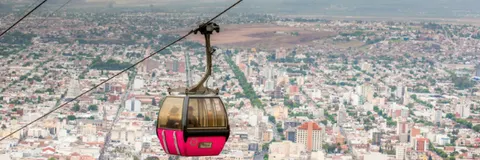
Next to the museum is Parque San Martín, home to the Teleférico San Bernardo, which takes visitors to the top of the hill of the same name and offers a beautiful view of the city. There is also a stunning artificial waterfall running along the entire length of the hill, forming artificial terraces that balance the beauty of the landscape with the lushness of the vegetation.
Museo Güemes (www.museoguemes.gob.ar): Tuesday to Sunday, 11hs to 19hs. Address: España, 730.
Teleférico San Bernardo (www.telefericosanbernardo.com): Monday to Sunday, 9hs to 18h30. Address: Av. San Martín, 4400.
Museo de Arqueología de Alta Montaña – MAAM (www.maam.gob.ar): Tuesday to Sunday, 10hs to 18h30 (check special holiday hours). Address: Mitre N° 77.
DAY 2
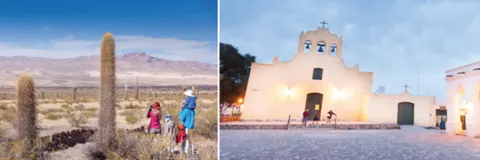
The drive from Salta to Cachí, via National Route No. 68, which connects at the town of El Carril with Provincial Route No. 33, is an experience in itself, as along the way there are many natural wonders worth a photo stop: the Cuesta del Obispo; the Piedra del Molino, one of the highest points in the mountains (3,340 m altitude), offering a panoramic view of the region and the Quebrada de Escoipe; the Parque Nacional Los Cardones, a "sea" of cardón cacti and Amancay flowers; and also the Recta del Tin-Tin, where a section of the Inca Trail that once lay in Argentina can be seen.
Arriving in Cachí, you can visit the Plaza 9 de Julio, home to the Iglesia de San José, a rustic and picturesque little church that surprises with its authenticity and simplicity, and the Museo de Arqueología Pio Pablo Díaz. The museum is named after a local resident who was an excellent observer and avid collector of artifacts he found throughout the Valles Calchaquíes, forming a vast archaeological heritage of items from different historical periods. His pieces were donated to create the museum.
Leaving Cachí along the well-known National Route No. 40, you pass through the Valles Calchaquíes, where the so-called Camino de los Artesanos is located, featuring a range of local craft shops, tea houses and art galleries set in a magical landscape surrounded by mountains and nature.
Do not miss the villages of Seclantás, Molinos and Angastaco, the last of which is home to the famous Quebrada de las Flechas. This gorge is a magnificent natural monument, whose origins date back 15 to 20 million years and which was formed by a lake that no longer exists.
This excursion ends in the city of Cafayate, where you can stay at one of its many hotels.
Museo de Arqueología Pio Pablo Díaz (www.culturasalta.gov.ar/organismos/museo-arqueologico-de-cachi/12): Tuesday to Sunday, 8hs to 18hs. Address: Juan Calchaquí, no number.
Camino de Los Artesanos (www.caminodelosartesanos.com.ar): High season – Every day, 10hs to 21hs, and low season – Friday to Sunday, 10hs to 21hs.
DAY 3
Cafayate is a small town 160 km from Cachí, which surprises with the beauty of the gorge that bears its name and with the quality of its Torrontés white wine. It is a grape originally from Spain, and Argentina is now its main producer.
In Cafayate, you should not miss the Museo de la Vid y el Vino, which presents, in a dynamic and interactive way, the origin and characteristics of the vines and wines of the region. On the town's main square stands the centuries-old Catedral Nuestra Señora del Rosario de Cafayate, which is also worth a visit.
Nearby is the Mercado Municipal de Artesanías de Cafayate, great for buying travel souvenirs.
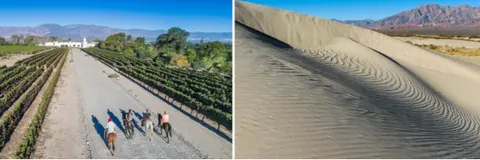
Cafayate is the second main winegrowing region in Argentina, and its Ruta del Vino is the highest in the world. It is recommended to visit two wineries and have lunch at one of them while tasting their delicious wines.
In the late afternoon, an unforgettable experience is a horseback ride in the Los Médanos area. 8 km from the center of Cafayate, this surprising region features valleys, vineyards, mountains, houses, golf and polo fields, and also white sand dunes, as if you were near the beach. The explanation is that millennia ago, the region was an ocean.
Museo de la Vid y el Vino (www.museodelavidyelvino.gov.ar): Tuesday to Sunday, 9hs to 19hs. Address: Av. Guemes Sur corner with Fermín Perdiguero.
Mercado Municipal de Artesanías de Cafayate: Monday to Sunday, 9hs to 22h30. Address: Av. Gral. Güemes Sur, 81.
DAY 4
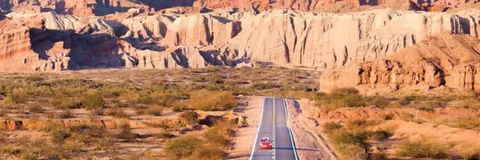
Heading back to the city of Salta via National Route No. 68, considered one of the most beautiful roads in the world, you will reach the magnificent natural reserve of Quebrada de las Conchas, a large valley in reddish and orange tones blended among curves formed by the collision of tectonic plates. In this region, nature has sculpted many shapes into the rock, but the highlights are the great cliffs of the Garganta del Diablo; the Anfiteatro, a huge natural acoustic shell eroded into the rock face; and the Tres Cruces lookout, from where you can see all of the Valles Calchaquíes.
At the end of the day, it is recommended to explore one of the many restaurants and bars in the city of Salta and sample its local snacks.
DAY 5
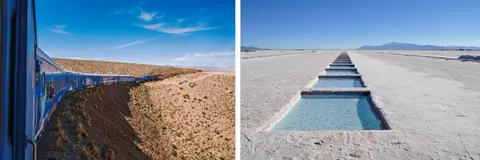
Leaving the city of Salta in the morning, take National Route No. 51 toward Puna, passing through the towns of Campo Quijano, also known as the "Gateway to the Andes," as it is the last populated town before the Quebrada del Toro, where you will find colorful hills, giant cacti and incredible views.
Along the way, it is recommended to have a rural breakfast in El Alfarcito, a small community on the route. Then the journey continues through the Quebrada de las Cuevas to finally reach San Antonio de los Cobres, where you board the Tren a las Nubes which, after an hour's journey, arrives at the Viaducto La Polvorilla, located 4,200 meters above sea level, considered one of the most imposing engineering works of the last century. You get off the train at this point to explore the site and, after thirty minutes, board the train again to return to San Antonio de los Cobres.
90 km from San Antonio de los Cobres along National Route No. 40, you will find the Salinas Grandes, which link the provinces of Salta and Jujuy. It is considered the third largest salt flat in the world, covering about 12 thousand hectares. During the rainy season, it forms a 30 cm layer of water, creating an unmatched view of the place.
After visiting the Salinas Grandes, another mandatory stop in Jujuy is the picturesque village of Purmamarca, whose name means "City of the Virgin Land" in Quechua. It features pre-Hispanic architecture and was once a stopover on the Inca Trail, and today it is recognized as a UNESCO World Heritage Site.
For accommodation, Purmamarca has small hotels with personalized service and very beautiful views.
Tren a las Nubes (www.trenalasnubes.com.ar)
DAY 6
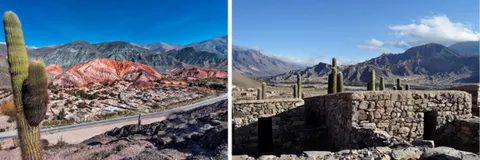
In the morning in Purmamarca, a visit to the Iglesia Santa Rosa de Lima should not be missed, as it is a small church dating from the 17th century with many features worth seeing. Then, following the 3 km Paseo de los Colorados, which leaves from the village and runs along the bed of a tributary of the Río Purmamarca, you can observe magnificent figures carved by nature into the mountainsides and discover marvelous and unforgettable landscapes.
Still in Purmamarca, you should not miss its main tourist attraction, the Cerro de los Siete Colores, a mountain of incredible beauty made up of seven extremely well-defined colors that hardly look real. Its different layers of color are the result of marine, lacustrine and fluvial sediments.
Continuing along the same route north for about 25 km, you reach Tilcara. Exactly 1 km away is the Pucará de Tilcara, the most important archaeological site in Argentina. The area was a settlement of pre-Columbian peoples, as it sits in a strategic location at the crossroads of ancient roads, which made it possible to control access to the entire northwest region. The site covers 15 hectares and is divided into different sectors, such as housing, corrals, the ceremonial center and a cemetery.
Returning to Tilcara, you will find the beautiful Iglesia Nuestra Señora del Rosario, declared a National Historic Monument. Its beauty is undoubtedly enhanced by the natural scenery surrounding it, where the colorful hills serve as a backdrop.
Pucará de Tilcara: Monday to Sunday, 9hs to 18hs.
DAY 7
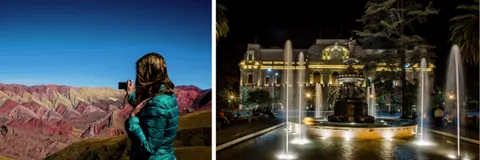
From Tilcara, continue a few more kilometers north to reach the town of Humahuaca, also in the province of Jujuy, which was once an indigenous settlement and gave its name to the gorge known as the Quebrada de Humahuaca, an ancient trade route of the Inca Empire. It consists of several mountain ranges arranged in a fan shape. Its main tourist highlight is the Serranía de Hornocal, a rocky range made up of hills in 14 different colors. Its limestone formation comes from various minerals that, through erosion, leave triangular formations of many colors across the mountains.
Returning toward the city of Salta, the last stop should be the city of San Salvador de Jujuy, the provincial capital. It is located in a valley crossed by the Grande and Xibi-Xibi or Chico rivers, 1,259 meters above sea level. Many of its public buildings are true architectural gems worthy of appreciation, among which the Casa de Gobierno de Jujuy stands out, with its historic pavilion preserving unique relics in Argentina, including the Bandera Nacional de la Libertad Civil. Religious architecture is also part of the city's attractions, with unique buildings such as the Iglesia Catedral and the Iglesia San Francisco, with its Museo de Arte Sacro.
Iglesia San Francisco and Museo de Arte Sacro: Monday to Saturday, 9hs to 13hs and 17hs to 21hs. Address: Gral. Belgrano 677.
This marvelous journey, with unforgettable and unique attractions across the regions of Salta and Jujuy, allows you to enjoy beautiful landscapes as well as their precious history and culture. Without a doubt, it is a destination that every Brazilian should not miss!
INFORMATION
Ministry of Tourism of Salta
Ministry of Culture and Tourism of Jujuy
1