
With Spotify, Tramontina Creates the First Synesthetic Algorithm That Turns Music Into Flavor

· 3 min read
Translated with AI assistance.Read the original in Portuguese

Sabor das Músicas aims to refresh the brand and encourage stainless steel cookware use through neuroscience and artificial intelligence
The Sabor das Músicas project was created with the goal of refreshing the brand and inspiring people to cook, proving that stainless steel is more than a pan. It is a world of possibilities. To bring the brand closer to the pop world, nothing works better than music. That led to the idea of creating an algorithm that turns any song on the Spotify platform into a different recipe. In total, it is capable of generating 44 million possible gastronomic combinations.
To develop this project, Tramontina – a leading kitchenware brand in Brazil -, Spotify and J. Walter Thompson Brasil brought together neuroscientist Dr. Marcelo Costa, head of the Neuroscience Department at USP, maestro João Rocha of the University of Kentucky, and Renato Carioni, chef and coach of the Brazilian Bocuse d'Or team, to give flavor to songs and create a dish for each one.
"Our goal with this action is to bring stainless steel cookware closer to young audiences. Once seen as a traditional pan, the item needs to be known as a versatile product for different uses, formats and finishes, in a world of possibilities," says Darci Friebel, director of the factory that produces more than 400 thousand stainless steel pans per month, for Brazil and abroad. The unit is part of a group of 10 Tramontina factories in the country.


It is not mad science. It took six months of study. The first step was the work of the neuroscientist and the maestro in filtering the parameters used by Spotify, applying the principle of synesthesia* to classify the millions of songs available in its database. "If you consider a samba school with its various instruments, that very dense sonic material, you can relate it to a dense food," explains Rocha.
Thus, the duration parameter became ingredients; danceability was classified as temperature; energy became density/texture; positivity became bitterness/acidity and musical key became harmonization. Based on these parameters, the chef classified all the main culinary ingredients, assigning scores to each one. "If a song is not positive at all, its flavor is bitter," says Carioni.
All this database was brought together and gave rise to an artificial intelligence that uses the same technology found in financial systems, to "make a match" between Spotify's classification parameters and the different ingredient combinations cataloged by Carioni. This is how the dishes were reached.
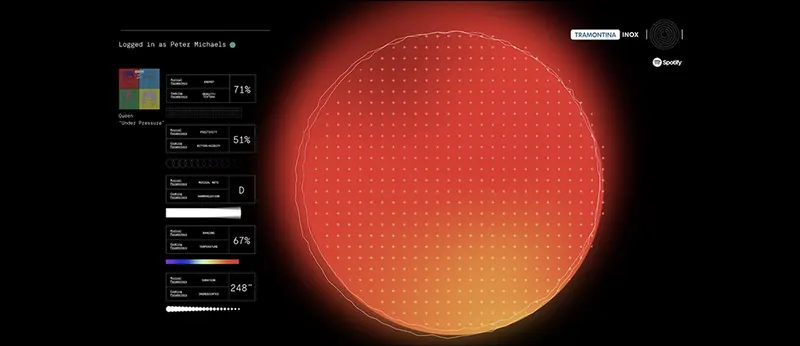
It sounds complicated, but visiting the microsite sabordasmusicas.com.br of this delicious experiment makes it easy to understand. There, users can find out, in real time, the exact flavor of any song. Beethoven's Symphony No. 5 in C Minor, for example, became a Foie Gras Terrine with Salmon Roe.
"The idea behind the algorithm arose to meet Tramontina's brief, which was to bring its stainless steel line and its many possibilities closer to a younger, tech-savvy audience. The result was a very complex project, but a very tasty one to listen to and to savor," says Rodrigo Da Matta, ECD at J. Walter Thompson Brasil.

* Synesthesia is a brain condition characterized by the overlap of senses.