
Travel Techs Should Offset Pandemic Losses in the Tourism Sector

By Julia Paiva
· 6 min read
Translated with AI assistance.Read the original in Portuguese

See the 12 travel techs expected to drive the tourism segment in 2021. Consumers will be the winners of the competition!
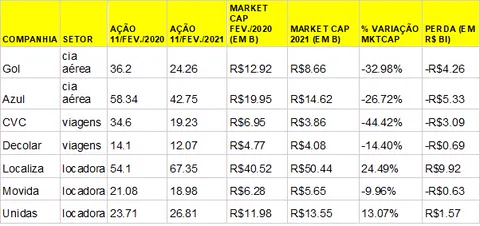
Brazil's tourism market was one of the hardest hit by the Covid-19 pandemic. In the last year (Feb. 2020-Feb. 2021), GOL and AZUL together lost about R$9.5 billion in market value, while CVC fell 44%, dropping from R$6.9B to R$3.86B. Decolar ranked fourth, losing R$1.94B over the period analyzed (see table below).
Still, the acceleration of digital habits among consumers in every segment and the creation of attractive campaigns in the sector kept the losses from being even greater.
There have never been so many promotional packages and offers on travel websites and apps as in 2020. We could even venture to say that travel techs (technology and tourism companies) saved the year, and they are expected to play a strong role in 2021 as well, considerably helping to push tourism sector numbers back up.
In this scenario, meet the 12 travel techs and mobility techs that stood out in 2020 and are expected to boost their performance even further in 2021:
1 – Hurb: One of the few tourism companies that grew in 2020. They even offered packages to New York and Tokyo, with round-trip airfare and accommodation for less than R$3 thousand, with the dollar above R$5. It is by far the leading hotel player in Brazil, and the company's goal is to become a global company. To that end, it invests in technology, big data, artificial intelligence algorithms, without neglecting the human touch, through in-house rather than outsourced customer service, unlike some international OTAs (over-the-air) .
2 – MaxMilhas: Although it lost sector leadership to 123Milhas, the Minas Gerais-based MaxMilhas is expected to bounce back strongly in 2021. The company has already announced it will enter other segments, such as package and hotel sales, promising to be one of the leading OTAs in 2021, since it has cutting-edge technology and an extensive user base.
3 – 123Milhas: After taking over all the media space in major airports over the last three years with photos of Zezé di Camargo wearing baby look shirts and even of Decolar's former boy wonder, Bruno de Lucca, 123Milhas is the one to watch. The company got ahead in the race against MaxMilhas, in 2020 it added hotels, travel packages, insurance and even cars to its platform, becoming a complete OTA. The big news is the launch of a physical store, 123Milhas in a franchise model, which should scale its growth in 2021.
4 – Instaviagem: The proposal here is to offer personalized trips through a hybrid model that blends technology and specialists. As a result, the company raised an investment last year from venture capital manager DOMO Invest. The startup also has an option where the customer creates a "surprise destination": based on a few variables, such as trip length, destination (domestic or international), type of accommodation (resort, hostel, hotel, etc.) and mode of transport (bus, car or air) provided by the user, Instaviagem creates a completely unique trip suggestion.
5 – Zarpo: With seven million customers, the company has a highly niche proposition, focusing on offering strong curation of hotels. To access any price, you must be logged in, which gives the platform an interesting advantage, since it can get around the rate parity rules required by hotels by offering exclusive prices to "members". In addition, by focusing on less content than other OTAs, it can have greater bargaining power, which is passed on as more discounts. In November 2020, Zarpo recorded record sales, benefiting from the behavior of new travelers during the pandemic who, with international borders closed, opt for "shorter" trips.
6 – Onfly: The startup has been growing and in 2020 alone billed R$8 million with its unique proposition of managing business travel in Brazil, focusing on corporate clients. It also received investment from Grupo Cedro Capital at the start of 2021. With an intuitive platform, the company seeks to democratize a technology that was previously exclusive to a few companies, enabling travel bookings, expense reimbursement workflows, digitizing the entire traveler journey, eliminating email and paper exchanges, delivering management and data so the travel manager can make smart decisions, and ensuring security for company shareholders, with reduced fraud and greater transparency.
7 – Bank3: Bank3 is a fintech focused on travel, with a virtual credit card solution (VCN) that also offers cashback. It represents a convergence between financial services and tourism services, with everything in place to succeed in 2021.
8 – Let's book / Pmweb: The big insight here is direct sales. Pmweb, with its Let's book solution, offers technology so hotels depend less on intermediaries and OTAs. It is a booking tool for hotels and a CRM solution to help them build relationships with guests after checkout and thus increase guest loyalty.
9 – Asksuite: The company created a chatbot to be embedded in hotel websites, where users can get a quote and book a room in a few seconds directly through the chat. The interesting thing about this solution is that, besides allowing hotels to increase the conversion of visitors into guests, it eliminates much of the need for hotels' "sales" departments, historically a department with very little technology applied. Asksuite is from Santa Catarina and last year it announced a R$4 million investment from ABSeed, a fund specialized in SaaS (software as a service) companies.
ALSO SEE: Vaccine tourism worries American authorities
10 – Voa Hotéis: The proposal of the startup Travel Techs is to deliver a brand for independent hotels, with a standardized management model and a range of software at no cost so that the small hotel can attract more guests and achieve greater profitability. In Brazil, independent hotels represent 87.9% of the market, making it fertile ground for models like Voa Hotéis.11 – Flapper: Based in Belo Horizonte (MG), with offices in several Latin American cities, the startup aims to transform air mobility with a "boutique" solution at a very affordable price. It is the "Uber of helicopters." In 2020, the company raised R$2.5M through equity crowdfunding to accelerate its growth over the next five years.
12 – Fly Adam: Launched in early 2020, the company has an innovative air mobility platform that is revolutionizing the market, as it allows chartering an aircraft anywhere in Brazil and abroad from a cell phone or computer, without having to request multiple quotes from different companies. Recently, ANAC (National Civil Aviation Agency) authorized the sale of individual seats on flights operated by air taxi companies, and Fly Adam is one of the first to distribute the sale of these seats.