
Portuguese Language Museum to Reopen with New Experiences for Visitors

By Julia Paiva
· 13 min read
Translated with AI assistance.Read the original in Portuguese
Portuguese Language Museum reopens to the public, rebuilt after a fire. Renewed content will combine unprecedented audiovisual experiences and striking installations
The Museum of the Portuguese Language, an institution of the Secretariat of Culture and Creative Economy of the State of São Paulo, will reopen on July 31, rebuilt after the fire that struck it in December 2015. One of the first museums entirely dedicated to a language, located in the city with the largest number of Portuguese speakers in the world, São Paulo, in the historic Luz Station, the Museum celebrates the language as a founding element of our culture. Through interactive experiences, audiovisual content and immersive environments, visitors are guided on a journey through the history and diversity of the language spoken by 261 million people around the world.
The official opening ceremony, on the 31st, will be broadcast live on the Museum's social media channels.
Public access will follow under the restrictions set by COVID-19 prevention measures. Tickets may be purchased exclusively online, with a set date and time, and public capacity is limited to 40 people every 45 minutes. Visitors will receive touchscreen keychains to avoid touching the interactive screens.
The reconstruction of the Museum of the Portuguese Language is an initiative of the Government of the State of São Paulo in partnership with the Roberto Marinho Foundation, with EDP as master sponsor; Grupo Globo, Grupo Itaú Unibanco and Sabesp as sponsors; and support from the Calouste Gulbenkian Foundation and the Federal Government through the Federal Culture Incentive Law. ID Brasil Cultura, Educação e Esporte is the social organization responsible for its management.
Revised and expanded content
The Museum's content has been updated. In its long-term exhibition, the Museum will feature unprecedented experiences as well as others that already existed, which marked the public during its 10 years of operation (2006-2015). Among the new installations are "Línguas do Mundo" (Languages of the World), which highlights 23 of the more than 7 thousand languages spoken today in the world; "Falares" (Ways of Speaking), which presents the different accents and expressions of the language in Brazil; and "Nós da Língua Portuguesa" (Us and the Portuguese Language), which presents the Portuguese language in the world, with the ties, entanglements and cultural diversity of the Community of Portuguese Language Countries (CPLP).
The main experiences remain in the collection, such as the installation "Palavras Cruzadas" (Crossed Words), which shows the languages that influenced Portuguese in Brazil; and the "Praça da Língua" (Language Square), a kind of 'planetarium of the language' that honors the Portuguese language written, spoken and sung, in an immersive show of sound and light. (See the full content below)
Curated by Isa Grinspum Ferraz and Hugo Barreto, the content was developed with the collaboration of writers, linguists, researchers, artists, filmmakers, screenwriters, graphic artists, and other professionals from various Portuguese-speaking countries. Names include musician José Miguel Wisnik, writers José Eduardo Agualusa, Mia Couto, Marcelino Freire and Antônio Risério, slam poet Roberta Estrela d'Alva and documentary filmmaker Carlos Nader. Among the participants in experiences featured in the exhibition design are artists such as Arnaldo Antunes, Augusto de Campos, Laerte, Guto Lacaz, Mana Bernardes and others.
The temporary exhibition marking the Museum's reopening, "Língua Solta" (Loose Tongue), presents the Portuguese language in its broad and diverse developments in art and everyday life. Curated by Fabiana Moraes and Moacir dos Anjos, the show connects art to politics, life in society, everyday practices, and forms of protest and religion, through objects always anchored in the use of the Portuguese language.
The Museum was also designed with physical and content accessibility features.
New terrace and reinforced fire safety
One of São Paulo's main historic buildings, a landmark of the city's development and beloved by the entire population, Luz Station has a unique symbolic importance: it was one of the gateways for thousands of immigrants who arrived in Brazil. It was there that, after disembarking from ships in Santos, they had their first contact with the Portuguese language.
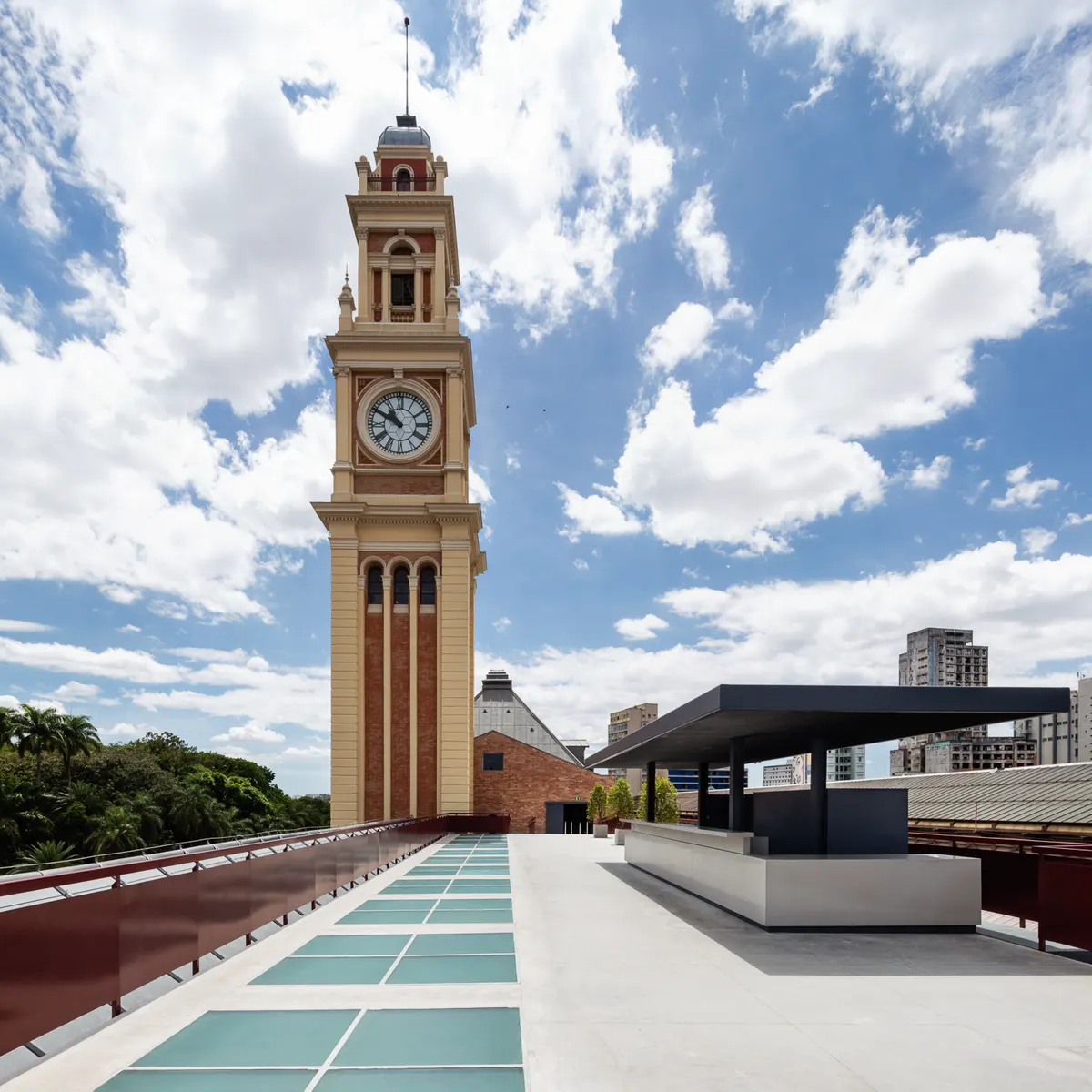
With the complete architectural restoration and readaptation of its interior spaces, which involved restoration and reconstruction work, the Museum kept the structuring concepts of the original intervention project, designed by architect Paulo Mendes da Rocha and his son Pedro in 2006, and gained improvements. On the ground floor, the museum opens to the station, strengthening its connection with the city. On the upper floors, spaces were optimized, new materials were introduced, and the museum gained more rooms for its installations. And on the third floor there will be a terrace overlooking Jardim da Luz and the clock tower. This space will pay tribute to architect Paulo Mendes da Rocha, who died this year. The new version was conceived by Pedro Mendes da Rocha and developed in the pre-executive and executive design stages by Metrópole Arquitetura, under the coordination of Ana Paula Pontes and Anna Helena Villela.
The reconstruction also incorporates infrastructure and safety improvements, especially against fires, which exceed the requirements of the Fire Department. Among the new measures is the installation of sprinklers (automatic sprinklers) to reinforce the fire safety system. In the Museum's case, the sprinklers are not a legal requirement, but a recommendation from the firefighters that was adopted to bring more safety to the project.
The Museum and Luz Station obtained the joint Fire Department Inspection Certificate (AVCB), which guarantees safety for all Station users. It is the first time Luz Station has obtained the AVCB, thanks to the joint effort of the Museum and the São Paulo Metropolitan Trains Company (CPTM).
All stages were approved and closely monitored by the three historic heritage bodies: the National Institute of Historic and Artistic Heritage (Iphan); the State Council for the Defense of Historic, Archaeological, Artistic and Touristic Heritage (Condephaat); and the Municipal Council for the Preservation of the Historic, Cultural and Environmental Heritage of the City of São Paulo (Conpresp).
Sustainability: focus on the LEED seal and reclaimed wood
The museum will also reopen with environmental certification. Sustainability guidelines guided the entire project, and the Museum obtained the LEED (Leadership in Energy and Environmental Design) seal, one of the most important in the world for sustainable construction, in the Silver category. Measures include adopting energy-saving techniques in the museum's operation; waste management during the works; and the use of wood that meets sustainability requirements (certified and reclaimed from demolition) throughout the Museum.
About 85% of the wood needed to restore the window frames came from the building's existing material, reusing wood from the original roof, dated 1946. In building the new roof, 89 tons (67 m³) of certified wood from the Amazon were used.
More than 300 window frames were restored or remade, in work that gave new life to woods over 70 years old, dated 1946. In the woodworking shop installed on the building's first floor, partially charred material (peroba do campo, pink and yellow) was restored and reused in the project. The challenge was to recover the building, within current restoration techniques, preserving all its historic aspects: the restorers used models recorded at the beginning of the 20th century, when Luz Station was built; in 1946, when the building was also hit by a fire; and small modifications made in 2006 to use the building as a museum.
The resources needed for the reconstruction of the Museum of the Portuguese Language were R﹩ 85.8 million, with most of the amount coming from a partnership with the private sector via the federal culture incentive law and fire insurance compensation.
About 4 million visitors in 10 years
In nearly 10 years of operation, from March 2006 to December 2015, the Museum received about 4 million visitors and hosted another 30 temporary exhibitions. Among those honored with exhibitions were writers such as Guimarães Rosa, Clarice Lispector, Machado de Assis and Fernando Pessoa, as well as singer and songwriter Cazuza. The Museum was hit by a fire on December 21, 2015.
During the reconstruction, the Museum stayed in touch with the public through cultural and educational activities, such as those held on the International Day of the Portuguese Language at Luz Station since 2017, and the traveling exhibition "A Língua Portuguesa em Nós" (The Portuguese Language in Us), presented in 2018 in Portuguese-speaking countries in Africa, in Portugal and in Brazil. In 2020 and 2021, the International Day of the Portuguese Language was held virtually, with a series of online events that brought together artists from various Portuguese-speaking countries.
LEARN MORE
TEMPORARY EXHIBITION (1st Floor)
The Museum's 1st floor is dedicated to temporary exhibitions. The show "Língua Solta", which presents the many developments of the Portuguese language in art and everyday life, marks the reopening of the space. It features 180 pieces, ranging from embroidered mantles by Bispo do Rosário to a projection of memes by the collective Saquinho de Lixo, curated by Fabiana Moraes and Moacir dos Anjos. Visitors will encounter the blending proposed by the curators, connecting art to politics, life in society, everyday practices, and forms of protest, religion and survival, always crossed by the Portuguese language. Street posters, cordel chapbooks, toys, wall coverings and cachaça labels mix with works by artists such as Mira Schendel, Leonilson, Rosângela Rennó and Jac Leirner, among others.
LONG-TERM EXHIBITION (2nd and 3rd Floors)
2nd floor – Journeys of the Language. Experiences:
Languages of the world
In one of the Museum's new experiences, 23 masts are spread across the 2nd-floor hall, each with audio in a language. They present greetings, poems, excerpts of texts and songs in recordings made by speakers of Portuguese, Spanish, Italian, German, French, English, Russian, Hindi, Greek, Armenian, Farsi, Arabic, Yiddish, Mandarin, Japanese, Korean, Turkish, Yoruba, Kimbundu, Quechua, Guarani-Mbyá, Yanomami and Basque. The languages were chosen from among the 7 thousand existing in the world according to their ties with Brazil, mainly through immigration, or for representing different regions of the world and their language families.
Family ties
The theme of the world's many languages and their organization into families continues along the wall of the Rua da Língua corridor. An animated diagram unfolds to show the evolution of the Indo-European family, to which Portuguese belongs, and the kinship among language groups.
Rua da Língua (Language Street)
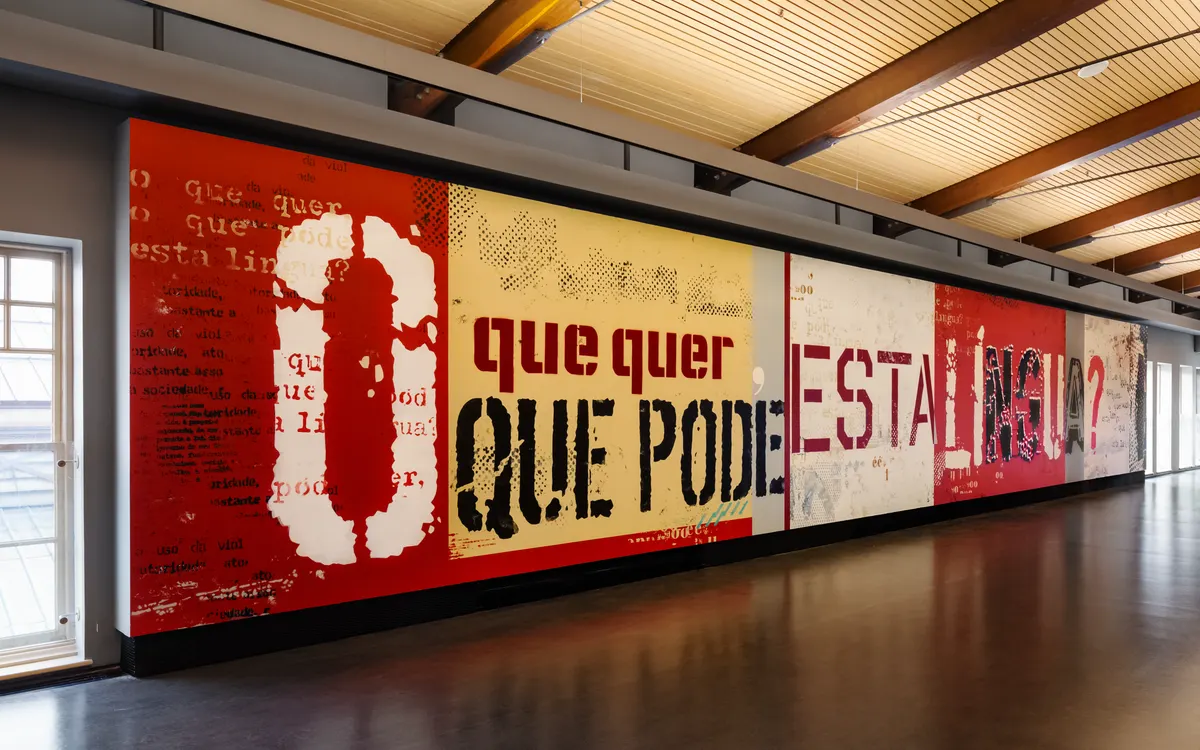
The installation that stretches across the entire Grand Gallery, mimicking the train line of Luz Station a few floors below, has had all of its content renewed. To invite visitors to reflect on language in contemporary urban life, the screens "transform" into walls, murals and billboards. As on city streets, the lightning-fast poetry of learned and popular verbal fragments emerges: expressions, proverbs, graffiti, poems, advertising, anonymous inscriptions of the big city, in surprising designs.
These are creations by artists such as Augusto de Campos, Arnaldo Antunes, Guto Lacaz, Felipe Grinaldi, Fábio Moraes, GG (Susto), Mana Bernardes and Coletivo Bijari, based on specialized consulting by José Miguel Wisnik and Antonio Risério, with scripting by Wisnik and Leandro Lima. The experience has an original soundtrack by Alê Siqueira and Cid Campos.
Word alley
One of the experiences that remained in the Museum, with renewed technology. On the interactive tables, visitors form words, discovering in a playful way the origin of words in the Portuguese language and the secret mechanisms by which our language can always renew itself. The consulting is by linguist Mário Viaro, with scripting by Marcelo Tas.
Crossed words
One of the Museum's main exhibition spaces since its opening, it also had its multimedia technology renewed. Eight interactive totems with audiovisual resources and an explanatory panel display the influences of the main languages and peoples that helped shape Brazilian Portuguese. Navigation can be done by word, discovering its form and pronunciation in its language of origin, or by people, exploring their culture, traditions and arrival in Brazil.
Brazilian Portuguese
Studying Brazilian Portuguese is also studying the history of the country's formation and its people. This Timeline moves through different historical periods, from the Roman Empire and the Arab World, through the Great Navigations, Indigenous and African influences, to current issues, through a combination of different exhibition resources, such as display cases with objects, texts, testimonies from specialists, animated maps, historical videos and literary works.
Ties of the language
The installation "Nós da Língua Portuguesa", a novelty in the exhibition that expands the presence of the Community of Portuguese Language Countries (CPLP) in the Museum, has a dual purpose. On one hand, to show the established presence of the Portuguese language in the world: the language is spoken today on five continents by 261 million people. On the other, to map its new movements.
It was conceived from texts and consulting by specialists and writers such as the Angolan José Eduardo Agualusa and the Mozambican Mia Couto. "At the same time that it was an instrument of colonial domination, the Portuguese language was already the opposite of that: a fundamental component in the creation of autonomous cultural identities, in Brazil, Angola, Mozambique, Cape Verde, São Tomé and Príncipe and Guinea-Bissau", says the text signed by the two writers.
In the audiovisual installation, the common points and diversity that mark the Portuguese language in the world are revealed through three axes: the exchange among peoples who share the same language; the rupture of the colonized with the language of the colonizers; and invention, with the exchanges that continue to enrich the language today. Visitors navigate through different faces and accents; historical images; conflicts; landscapes; cultures and forms of communication that make up the identities of the countries.
3rd floor – What this language wants and can do. Experiences:
Falares (Ways of Speaking)
"Falares" is how the language expresses itself in the speech of Brazil, in its territories and bodies: in slang, in the speech of older people, in street language, in prayers, in children's games. One of the Museum's new audiovisual experiences, with consulting by Marcelino Freire and Roberta Estrela D'Alva, script and direction by Tatiana Lohman, forms a mosaic of a diverse Brazil.
Nine large vertical screens, which portray anonymous people and famous figures such as cartoonist Laerte, form a kind of "grove" of ways of speaking, showing the diversity of Brazilian Portuguese and its geographic and sociocultural variations. Visitors walk among the screens, perceiving different aspects of the living Portuguese language. The testimonies play in loop, with some connection between words, expressions and topics. A multimedia station allows visitors to deepen their research on linguistic variation, with the country's collection of ways of speaking, testimonies about the language and explanations from specialists.
What the language can do
In the auditorium, visitors are invited to immerse themselves in a poetic film about the development of language and its creative power, conceived and directed by Carlos Nader.
Language Square (Praça da Língua)
One of the Museum's original experiences, the Language Square, a kind of 'planetarium of the language', retains part of its content, honoring the Portuguese language written, spoken and sung in an immersive show of sound and light.
Conceived by José Miguel Wisnik and Arthur Nestrovski, it brings a mosaic of music, poetry, literary excerpts and testimonies in Portuguese, from Carlos Drummond de Andrade to Dorival Caymmi, passing through Fernando Pessoa, Nelson Rodrigues and Lamartine Babo, performed by names such as Maria Bethânia and Matheus Nachtergaele.