
Antarctica, a contemplative adventure

· Updated · 4 min read
Translated with AI assistance.Read the original in Portuguese
Text and Photos: Heitor and Silvia Reali
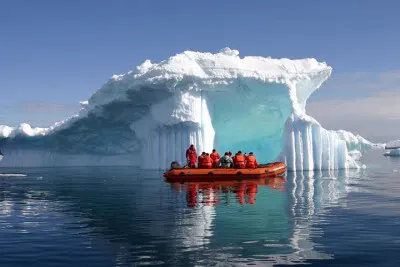
Forget the stereotypes about this frontier, because Antarctica is far beyond the cold and the snow. It is impossible to capture in photographs the sublime, the vastness and, even more, to reproduce the complexity of that beauty. In this minimalist landscape – white mountains, sea and sky – the scenery is always changing. It seems like a prank of nature, because depending on the angle of the sunlight, the colors of the ocean, the sky and the ice shift. Shades of green and blue predominate in the icy waters. Cobalt and gray tones for the sky; for the mountains, ivory streaked with volcanic black. Gold appears, only to vanish shortly after, depending on the mood of the sun. The air is dry, and the marine landscape, due to the icebergs, is one of the most captivating spectacles of nature. With unusual sizes and shapes, they catch the effects of the sun and reflect them around them. Seeing them is always accompanied by the most beautiful adjectives a language can produce. From this geography emanates a fascination that borders on the grandeur of an epic voyage.

During the crossing, lectures are given and films about the continent are screened
The ace up the sleeve of this trip is the landings on land. Faced with an environment that seems hostile at first glance, we explore like a naturalist or an explorer who traversed the same region in past centuries. And we are swept up by the same amazement upon arriving in an unexplored, unknown world, full of beauty. The landscape there is no different from the time of those first adventurers.
When we come into contact with the local fauna, we are certain we are standing before a masterpiece of nature. We are welcomed by king penguins, the small gentoos or the macaronis, those with golden tufts on their heads, as well as by gulls, giant petrels, skuas, albatrosses, seals, sea lions and whales. After a few days they become old acquaintances, and spotting them produces moments of pure joy. But it is nature, always, that rules this territory. Climate changes are fast – in less than five minutes the blue sky and the brightness can close in under snowstorms – yet no one wants to leave the place. The aura of mystery surrounding the continent explains its strong attraction for so many people.

The landscape there is no different from the time of those first adventurers
Cruise itineraries favor glaciers, fjords, straits, islands and a pit stop at the Polish scientific station, almost next to the Brazilian Comandante Ferraz station, which is in ruins due to the fire that occurred three years ago. Visits also include the stations of Argentina, Chile and the United Kingdom, located at Port Lockroy, today transformed into a museum. All are on the Antarctic Peninsula.
To provide scientific support for the journey, lectures are given and films about the continent are screened during the crossing. “It is great to hear the lectures and the stories of the explorers. It creates an atmosphere of adventure and interaction with the place,” says British tourist Harold Finn, 67. He, in turn, is truly remarkable. Even though he is paraplegic, he did not miss a single day of landing. His capacity to overcome adversity moved me.

In contact with the local fauna, we are certain we are standing before a masterpiece of nature
Other wonders of Antarctica are not in the landscape, but in the stories of triumphs and defeats of the first explorers. The most impressive is that of the failed expedition of Sir Ernest Shackleton (1874-1922), who intended to cross this continent on foot in 1914. This account reads like fantasy, but it is pure reality. “Antarctica is a place that captivates your imagination and your soul.” Shackleton's words echo in the mind of everyone who has the privilege of visiting this continent. Paradise on earth. That is why the adventure there boils down to contemplation. It is the landscape that matters.

“From this geography emanates a fascination that borders on the grandeur of an epic voyage”
Logbook
Until recently, imagination was the only ticket to get there. Today the journey is possible. But first you must fly to the region known as the end of the world. From there, from Ushuaia, Argentina, or from Punta Arenas, Chile, you simply choose a ship for the most remote frontier of nature – Antarctica.
From October to mid-March, vessels cross the legendary Cape Horn and head out on expeditions of seven days, or more, to the Antarctic Peninsula. It is worth choosing the end of the season, when fare discounts often reach up to 50%.
Who takes you: climbtur.br, (tel. 11- 5052-6305)