
5 Perfect Places to Watch the Stars in Uruguay

By Julia Paiva
· 6 min read
Translated with AI assistance.Read the original in Portuguese
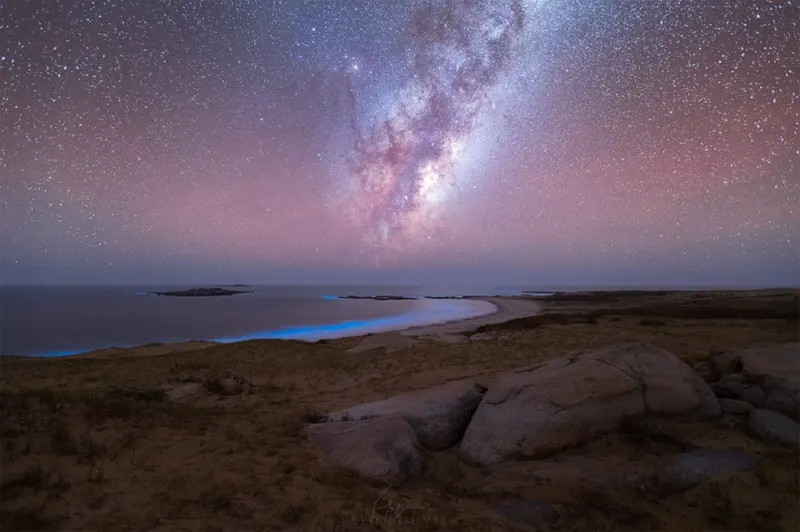
The magic of stargazing outside the city is an unforgettable experience. Together with Fefo Bouvier, astrophotographer and creator of the project “Mirá las estrellas”, discover five places in Uruguay where the sky still keeps its natural darkness —almost free of light pollution— so you can bring your camera, binoculars or simply enjoy the view.
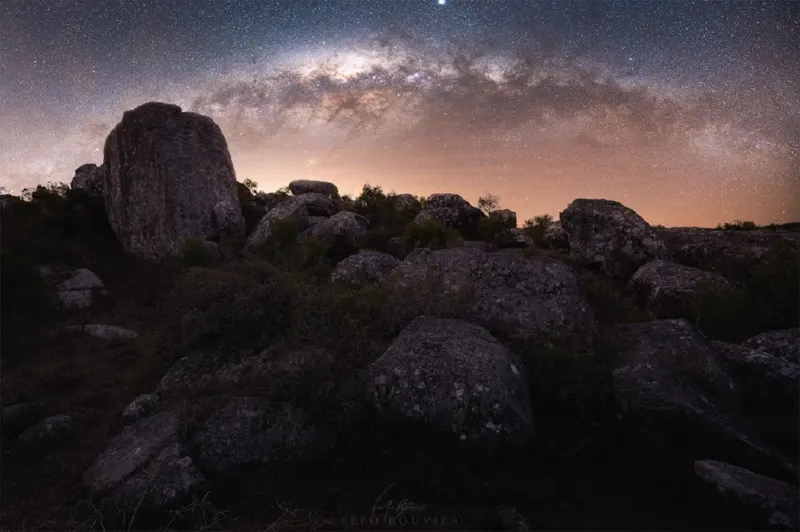
The Milky Way, hundreds of stars, planets, meteor showers and even neighboring galaxies will surprise your eyes. The galactic center, the brightest part of the Milky Way – visible to the naked eye as a broad band of light across the sky – is also seen from the Northern Hemisphere, but the advantage of observing it from the South is that when it is higher in the sky, during the austral winter, the nights are longer. Therefore, it can be observed for longer. Moreover, the cold makes the atmosphere pristine.
Here in the South, the Magellanic Clouds also stand out, visible to the naked eye as two whitish patches that stand out in the darkness of the night. These dwarf galaxies are located near the south celestial pole, so they cannot be observed from most northern latitudes. For this reason, they are a very interesting attraction for anyone who has never observed the southern sky, as well as for those from the South, along with the Andromeda galaxy.
Looking up and encountering the natural heritage of the dark sky is a gift of nature that can be enjoyed at many points in Uruguay, but here are five that stand out for clearly revealing the sky's features to the naked eye, for their easy access and for being tourist attractions in their own right.
To classify them, we rely on the Bortle Dark-Sky Scale, which measures the brightness of the night sky. This scale has 9 levels, with level 1 being the darkest sky on Earth and level 9 the sky seen from the center of a city.
1 – Cerro de la Buena Vista, Rocha
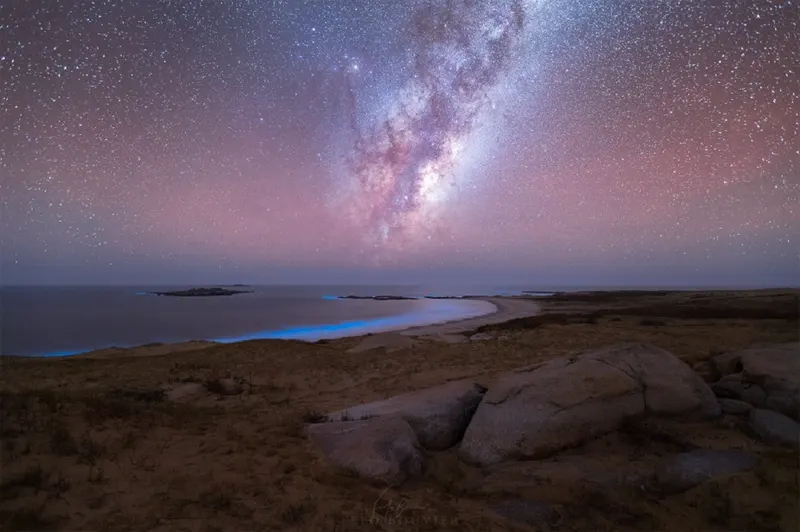
It is one of the main attractions of Barra de Valizas and, as its name suggests, it promises impressive views of the region. The invitation is to climb 56 meters to enjoy one of the most striking views in Uruguay. At night, it is undoubtedly one of the best places to enjoy the starry sky and the galactic center, which between the end of summer and the beginning of winter rises to the East over the Atlantic Ocean. Being an open, elevated landscape, it is ideal for seeing the arch of the Milky Way cross the sky from one side to the other.
With luck, you may see the water light up with flashes of blue light as it breaks on the shore, due to bioluminescence caused by single-celled marine organisms called “noctilucas”.
2 – Cerro Catedral, Maldonado
At 513 meters above sea level, it is the highest point in the country. It is one of the favorite spots of astrophotographers and astronomy enthusiasts for the quality of its dark sky. Also called Cerro Cordillera, it is part of the Serra del Carapé, a branch of the Cuchilla Grande that runs from Maldonado to Rocha.
There are no services in the area, so the suggestion is not to spend the night there, but to visit at dusk and observe the sky during the first hours of darkness. So many stars can be seen there that even the constellations easiest to recognize with the naked eye, such as Orion, no longer play a prominent role in the sky.
3 – Parque Salto del Penitente, Lavalleja
Famous for housing the country's tallest waterfall, it is one of Uruguay's most beautiful parks. Being located in the middle of the mountains, the predominant landscape is rocky and of native mountains. Light pollution is very low, so it is advisable to stay overnight to enjoy the night sky. The park has a lovely campground, with all services and cabins for rent.
Because it is safe and offers lodging, it is a perfect place to relax and enjoy meteor showers such as the Geminids in December or the Orionids in October.
4 – Protected Landscape of Valle del Lunarejo, Rivera
Considered the fourth Uruguayan wonder according to public preference, it is a protected landscape and part of the Quebradas del Norte area. It stands out for its landscape of hills, waterfalls, valleys and streams with lush vegetation. For lovers of flora and fauna, more than 160 species have already been sighted in the area. Inhabitants whose presence can be verified include the wild cat, the anteater, capybaras, otters, foxes and herds of coatis, among others.
There, the quality of the night sky is such that, in addition to seeing the Milky Way and stars in spectacular detail, it is possible to see the Zodiacal Light, a glow that makes the sky brighter at night toward the West after sunset. This is caused by the scattering of sunlight by dust particles found throughout the solar system.
5 – Sierras de Mahoma, San José
Known as the “sea of stone”, it attracts visitors with its 20 km² extent of rock formations, mainly granite. According to legend, the site's name honors Ohma, an indigenous man who lived there during the colonial period. Ideal for ecotourism and hiking. You can turn your hike into an adventure by joining the offerings of the local inn, with hikes, kayak trips and horseback rides. There you can also have lunch and stay.
From the viewpoint – where there is a 5-meter-tall cross – it is easy to see the Magellanic Clouds, the galactic arch and famous constellations such as the Southern Cross, Scorpius, Taurus and Orion.
When to watch the night sky in Uruguay?
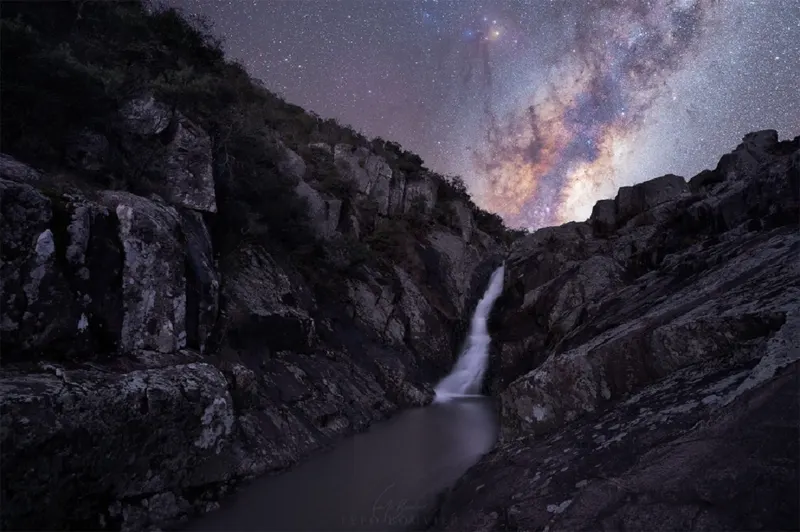
Between March and October – especially in winter – is the ideal time to observe the brightest part of the Milky Way, the galactic center. During summer, heading toward the Orion constellation (and the Three Marias), you can observe many bright stars. The Magellanic Clouds are visible all year, although they stand out most in spring.
When observing the night sky, it is recommended to choose a date close to the New Moon, since the Moon's brightness makes stars fainter and the Milky Way hard to see with the naked eye. Consult a lunar calendar to choose an ideal date.
Once on site, try not to use screens or flashlights so your retina can adapt to the dark. If you have no choice but to use a flashlight, make it red, as it is less dazzling. And be patient: total darkness arrives between one and two hours after sunset and lasts until dawn.